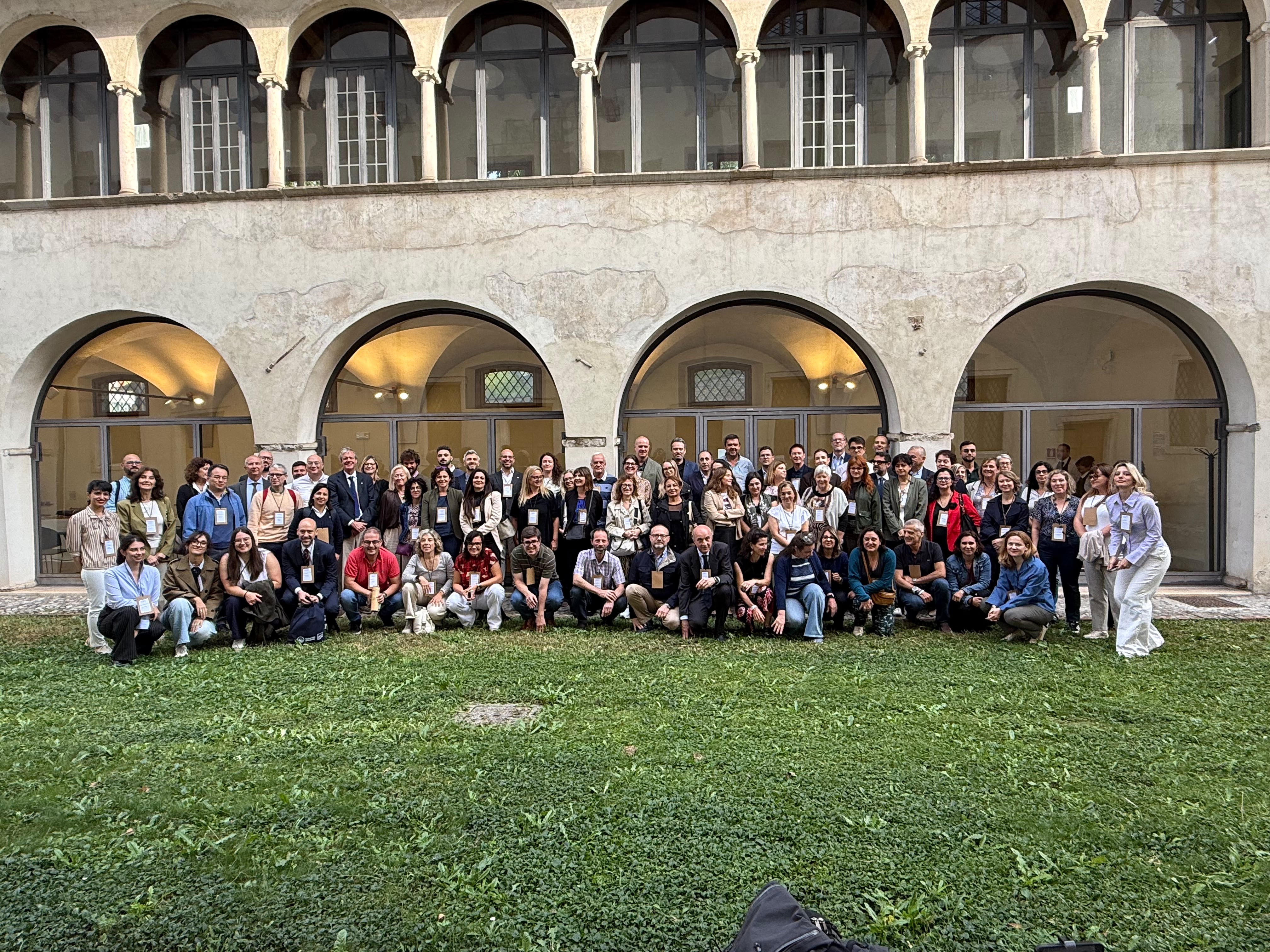
On 6 October, the Department of Economics and Management of the Università di Brescia hosted the final event of RECIPES for Internationalisation, a constellation project of the European University Alliance UNITA launched in 2023 with the aim of fostering the internationalisation of partner universities through practical tools designed for degree programmes, students, and university staff.
The event, organised by Prof. Carmen Marchiori and Prof. Corrado Paganelli, provided an opportunity to present and discuss the project's main outcomes. These included the Handbook for Internationalisation, which brings together tools and good practices for integrating the international dimension into different areas of university life, and the Self-Assessment Tool, developed to help degree programmes assess their level of internationalisation and identify potential pathways for further development.
Following the opening remarks by Roberto Ranzi, Vice-Rector for Internationalisation, and project coordinators Nicolas Meger and Ingrid Le Ru, the morning featured three keynote speeches addressing some of the major challenges facing the internationalisation of European higher education. Maurizio Tira, member of the Board of the European University Association (EUA), discussed the role of the EUA in supporting the internationalisation of higher education. Amélie Bensimon, representing HCERES, explored the relationship between internationalisation and the quality of university systems. Yann-Maël Bideau, Head of the European Universities Alliances portfolio at the Directorate-General for Education, Youth, Sport and Culture of the European Commission, retraced the origins and development of the European University Alliances initiative.
The discussions highlighted a vision of internationalisation that extends far beyond the mobility of students and academic staff. Internationalisation also means recognising the university as one of the places where the European project takes concrete shape. The values enshrined in the Charter of Fundamental Rights of the European Union - dignity, freedom, equality, solidarity, citizenship and justice - are also core university values: those of an open community founded on academic freedom, the exchange of ideas and the circulation of knowledge.
A second key theme that emerged was the close connection between research and teaching, one of the defining characteristics of university education. Universities are not merely places where already codified knowledge is transmitted through textbooks. Those who teach also contribute to the creation of new knowledge and bring into the classroom the questions, methods and findings arising from their own research. Teaching and research are therefore not separate activities; it is through their continuous interaction that higher education becomes capable not only of conveying what we already know, but also of teaching students to critically question what we do not yet know. From this perspective as well, internationalisation is essential, as bringing together different scientific communities, experiences and perspectives enriches both research and the quality of education.