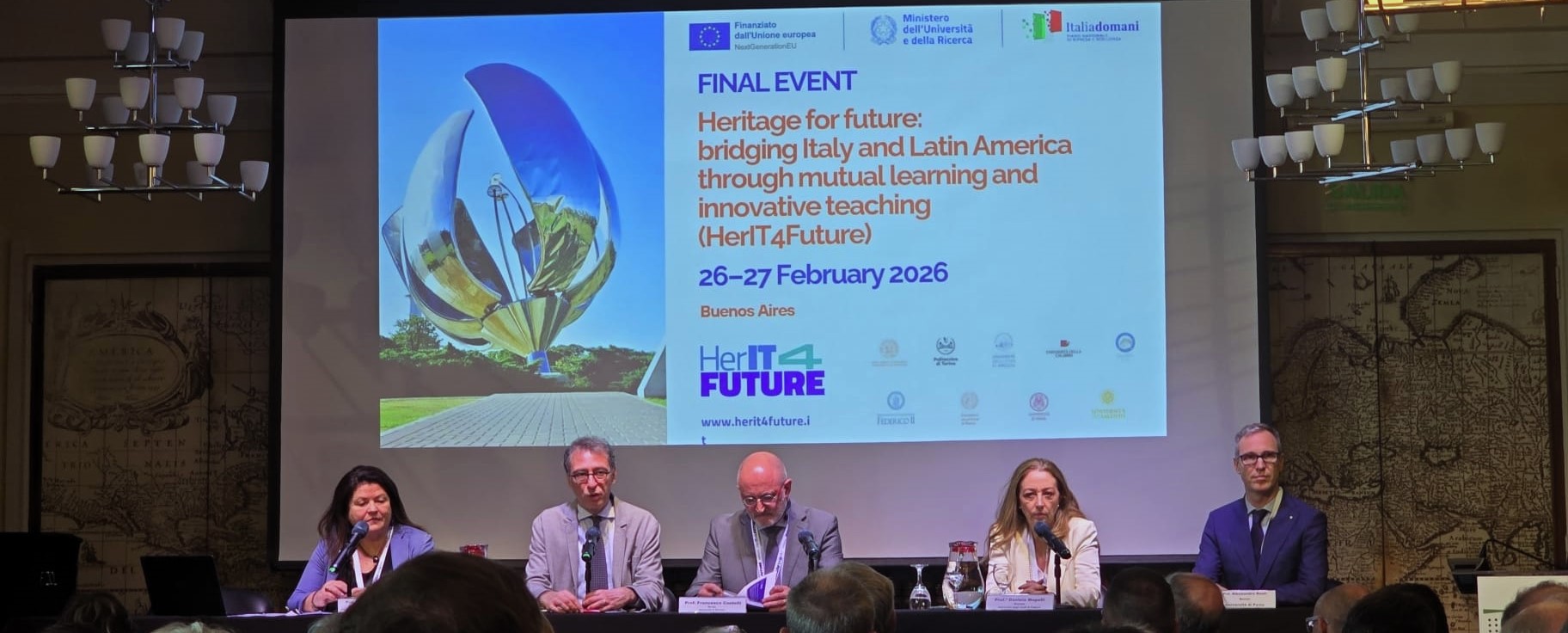
Rector Prof. Francesco Castelli and Vice Rector for International affairs Prof. Roberto Ranzi attended the closing event of the PNRR TNE Heritage for Future – HerIT4Future project (October 2024-May 2026) in Buenos Aires, at the headquarters of the Centro de Altos Estudios of the University of Bologna. The event opened with greetings from the Director of the Italian Cultural Institute in Buenos Aires, the Ambassador of the Italian Republic to Argentina, the Rector of the University of Bologna, and Minister Bernini, and was attended by numerous Latin American rectors (30 universities represented) as well as the Presidents of the Consejo Interuniversitario Nacional (CIN) and the Consejo de Rectores de Universidades Privadas (CRUP). The project was carried out by a partnership of nine Italian universities (the Universities of Brescia, Calabria, Messina, Naples Federico II, Padua, Pavia, Turin Polytechnic, and Salento), coordinated by the University of Bologna, also through the Center, and saw the participation of 69 Latin American universities in Argentina, Brazil, Chile, Colombia, Cuba, Ecuador, Mexico, Peru, and Uruguay.
The aim of the project was to strengthen existing relations between the Italian academic system and Latin American universities and to establish new ones. A wide range of interdisciplinary topics relating to cultural and natural heritage (a “legacy for the future”) were addressed through teacher and student mobility programs, advanced training courses, joint educational planning, and the development of multiple degrees. In this context, many parties reiterated their hope that mutual recognition of degrees would further contribute to promoting synergies between Italian and Latin American universities. In the long term, the project aims to consolidate relations between Italian and Latin American universities through the presence of the Buenos Aires hub, conceived as an open and dialogical space that encourages the development of joint research projects, the implementation of innovative teaching formats, and collaborations between universities and businesses in Italy and Latin America.
In this general context, the Università di Brescia has strengthened its relations with various universities, promoting the mobility of teachers and students with different countries and carrying out advanced training activities, in particular with two universities in Lima. The themes of the recovery of abandoned areas and the enhancement of cultural, social, and economic heritage have been explored in depth, using a multidisciplinary and co-design approach. The universities affirmed the importance of the role of academic systems in creating bonds and harmony between peoples. During the meetings held in Buenos Aires, a dialogue was initiated with other universities in Argentina, Mexico, and Ecuador, laying the foundations for further collaboration.