Studying at the Università degli Studi di Brescia continues to open doors to the job market. This is what emerges from the 28th Report on Degree Programs, presented as part of the conference “The Effectiveness of University Education,” organized by the AlmaLaurea Interuniversity Consortium together with the University of Basilicata and the Ministry of Universities and Research.
The 2026 Report examined the profiles of approximately 335,000 graduates from 2025 based on data from the 81 universities participating in AlmaLaurea, providing an in-depth snapshot of their key characteristics. Specifically, the Report on Graduate Employment Outcomes covered approximately 700,000 male and female graduates from 81 universities—holding both bachelor’s and master’s degrees—who graduated in 2024, 2022, and 2020, and were contacted one, three, and five years after graduation, respectively.
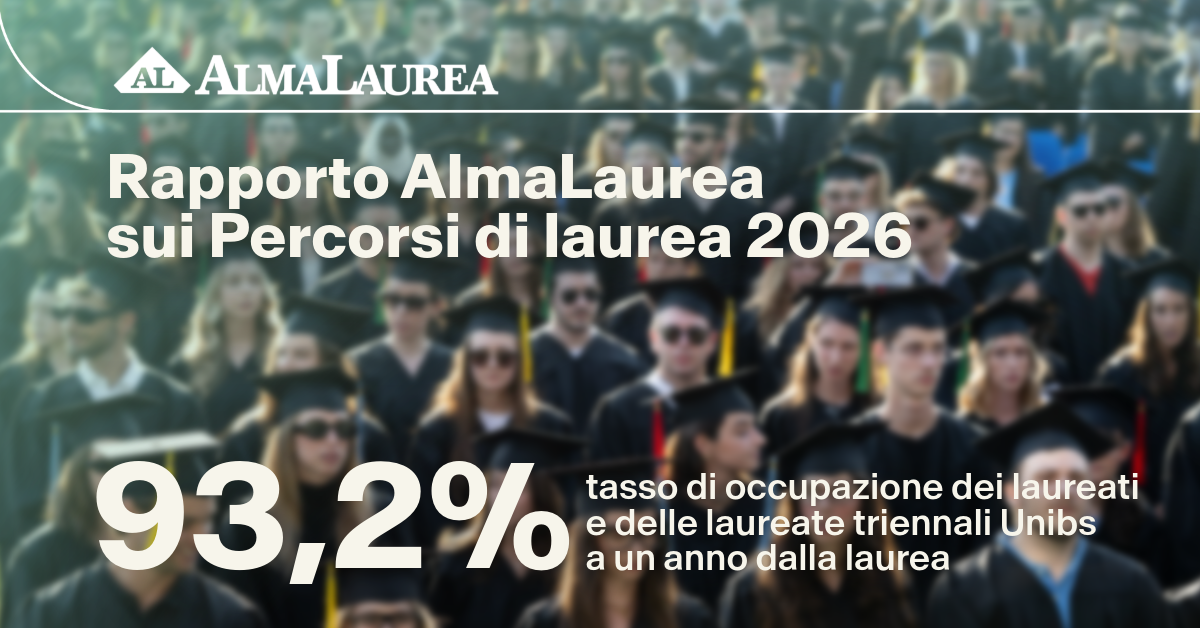
Employment data for bachelor’s and master’s degree graduates from the Università di Brescia remain above the regional and national averages this year as well. The percentage of bachelor’s degree graduates who find employment one year after graduation has risen to 93.2% (90.9% in 2025) (the regional average is 85%); while the employment rate for master’s degree graduates stands at 90.3% (88% in 2025)—compared to the regional average of 84.9% and the national average of 80.8%. Specifically, 97% (94.1% in 2025) of master’s degree graduates find employment five years after graduation. Salaries are also on the rise, averaging over 2,000 euros net per month for master’s degree graduates five years after graduation.
“The findings of the 2026 AlmaLaurea Report confirm the validity of our strategic choices and the strength of our educational programs, which have proven capable of responding promptly to the challenges of the job market,” states the Rector, Prof. Francesco Castelli. “The increase in the employment rate, as well as the rise in the percentage of students who complete their studies on time and the high level of overall satisfaction with the university experience, attest to our commitment to ensuring that our students have a solid and rewarding professional future, supported by above-average salaries,”
EDUCATIONAL BACKGROUND, UNIVERSITY GRADUATION RATES, CURRICULAR INTERNSHIPS, WORK DURING STUDIES, AND SATISFACTION WITH THE UNIVERSITY EXPERIENCE
The educational background of our graduates differs from the national average in that a smaller proportion come from high schools (58.2% compared to a national average of 71.5%) and a larger proportion come from technical schools (35.2% compared to a national average of 20.3%). 61.3% of students complete their degree within the expected timeframe with an average grade of 100.6 out of 110. A significant percentage—68.2%—worked while attending university, while 69.4% participated in internships recognized by their degree program. 87.1% of graduates are satisfied with their relationship with the faculty, and 80.9% consider the course load appropriate for the duration of the program. 83.8% of graduates report being generally satisfied with the instructional activities they participated in. More generally, 88.8% of graduates report being satisfied with their overall university experience. 71.7% of graduates would choose the same program and the same university again, while 9.1% would re-enroll at the same university but switch programs.
EMPLOYMENT OUTCOMES OF GRADUATES - UNIVERSITY OF BRESCIA
The survey on employment status covered a total of 4,793 graduates from the Università di Brescia. The data focus on analyzing the outcomes of first- and second-cycle graduates who graduated in 2024 and were interviewed one year after graduation, as well as those of second-cycle graduates who graduated in 2020 and were interviewed five years later.
EMPLOYMENT: BACHELOR’S DEGREE GRADUATES ONE YEAR AFTER GRADUATION
The survey involved 1,760 bachelor’s degree graduates from the class of 2024 who were contacted one year after graduation (in 2025).
By focusing specifically on the three-year degree graduates from the Università di Brescia who, after graduation, never enrolled in a master’s program (43.3%), it is possible to examine their employment outcomes one year after graduation.
One year after graduation, the employment rate (defined as all those engaged in paid work or training) stands at 93.2%, higher than the regional average (85%).
The unemployment rate (calculated based on the labor force—that is, those already in the labor market or intending to enter it) stands at 3.5% (compared to 6.8% for Lombardy).
Forty-eight percent of employed individuals have a permanent employment contract, while 24.5% have a fixed-term employment contract. Eleven point one percent are self-employed (as freelancers, independent contractors, entrepreneurs, etc.). Part-time work accounts for 8.6% of the employed population. Average monthly net pay is 1,682 euros.
69.9% of employed individuals consider their degree to be very effective or effective for the work they do. More specifically, 64.1% report making extensive use of the skills acquired at university in their work.
EMPLOYMENT: MASTER’S DEGREE GRADUATES ONE AND FIVE YEARS AFTER GRADUATION
There were 1,058 master’s degree graduates from the class of 2024 contacted one year after graduation (of whom 664 held two-year master’s degrees and 394 held single-cycle master’s degrees), while 997 graduates from the class of 2020 were contacted five years after graduation (of whom 544 held two-year master’s degrees and 453 held single-cycle master’s degrees).
One Year Later
The employment rate for master’s degree graduates is 90.3% (91.4% for two-year master’s programs and 88.4% for single-cycle master’s programs), higher than the regional average of 84.9% (84.6% for two-year master’s programs and 86% for single-cycle master’s programs) and the national average of 80.8%.
The unemployment rate, calculated based on the labor force, is 3% (2.8% for two-year master’s programs and 3.4% for single-cycle master’s programs).
34.5% of employed individuals have a permanent employment contract, while 11.5% have a fixed-term employment contract. 15.4% are self-employed (as freelancers, independent contractors, entrepreneurs, etc.). Among graduates of two-year master’s programs, these percentages are 47%, 13.3%, and 4.8%, respectively; among graduates of single-cycle master’s programs, they are 11.8%, 8.3%, and 34.5%, respectively. Part-time work accounts for 11% of those employed (4.6% among graduates of two-year master’s programs and 22.7% among graduates of single-cycle master’s programs).
Average monthly net pay is 1,762 euros (1,698 euros for those with two-year master’s degrees and 1,879 euros for those with single-cycle master’s degrees), which is higher than the national average (1,495 euros per month). 77.6% of employed graduates consider their degree to be very effective or effective for the work they are currently doing (68.8% among those with two-year master’s degrees and 93.4% among those with single-cycle master’s degrees); Furthermore, 71.1% report making extensive use of the skills acquired during their studies in their work (62.9% among those with two-year master’s degrees and 86% among those with single-cycle master’s degrees).
Five years later
The employment rate for 2020 master’s degree graduates, surveyed five years after earning their degree, is 97% (97.9% for two-year master’s programs and 96.1% for single-cycle master’s programs), higher than the regional average of 95.5% (95.3% for two-year master’s degrees and 95.7% for single-cycle master’s degrees) and the national average of 94.4%.
The unemployment rate is 1.7% (1.1% for two-year master’s programs and 2.4% for single-cycle master’s programs).
54.5% of employed individuals are hired under permanent contracts, while 6.1% are hired under fixed-term contracts. Seventeen percent are self-employed. Among graduates of two-year master’s programs, these percentages are 77.2%, 5.1%, and 11.6%, respectively; among graduates of single-cycle master’s programs, they are 29.1%, 7.3%, and 23.1%.
Part-time work accounts for 3.3% of employed individuals (2.2% among those with a two-year master’s degree and 4.5% among those with a single-cycle master’s degree). Average monthly net pay is 2,152 euros (2,112 for those with two-year master’s degrees and 2,196 for those with single-cycle master’s degrees), which is also higher than the national average (1,903 euros per month). 78.6% of employed graduates consider their degree to be very effective or effective for their current job (70% among those with two-year master’s degrees and 88.2% among those with single-cycle master’s degrees); 71.3% report making extensive use of the skills acquired at university in their work (65.6% among those with two-year master’s degrees and 77.7% among those with single-cycle master’s degrees).
But where do they find employment? 59.5% of graduates work in the private sector, while 39% work in the public sector; 1.1% work in the nonprofit sector. The services sector accounts for 72.5%, while industry accounts for 26.6% of those employed; 0.4% work in the agricultural sector. 87.2% are employed in the region where their university is located, 9.9% in another Italian region, and 2.3% work abroad.