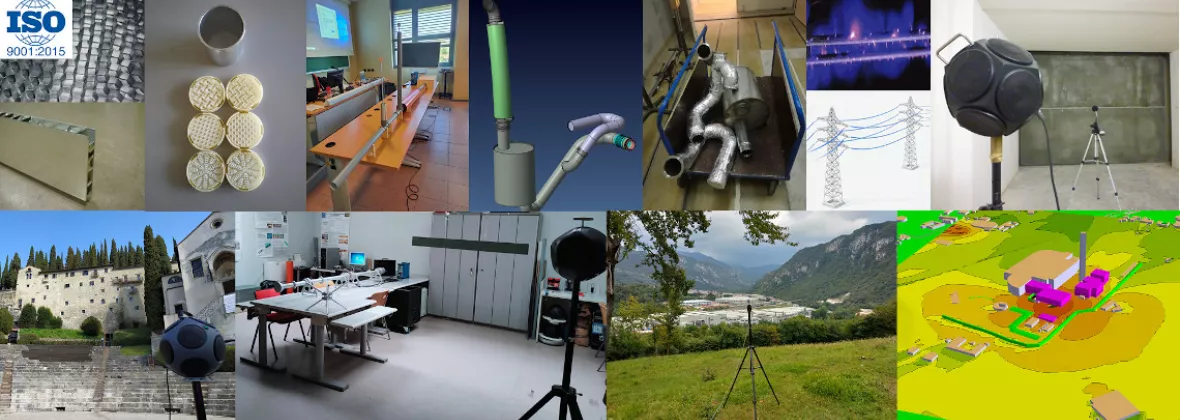
Applied Acoustics Laboratory (ISO 9001 certified)
The Applied Acoustics Laboratory was established to provide engineers with the essential tools for understanding and controlling issues related to sound and vibrations.
There is currently a growing demand for new expertise in the field of acoustics and vibrations, such as the development of complex sound propagation models and the prediction of materials’ sound absorption and sound insulation characteristics. This need is now the main driving force behind the activities of the Applied Acoustics Laboratory, which range from specialized consulting to research on innovative materials and technologies. To address these challenges, the laboratory is equipped with a range of certified professional instruments.
Contacts:
Edoardo Alessio Piana
Associate Professor, Ph.D.
Email: [email protected]
Tel.: +39 030 3715571
The Applied Acoustics Laboratory operates in several key areas of acoustics, providing both research and applied services. All of the activities described below can also be carried out on behalf of companies, industries, and public agencies, as part of specialized consulting, design support, experimental testing, and regulatory compliance verification.
Sound Propagation in Outdoor Environments
Activities in this area include sound level measurements and related analyses aimed at verifying compliance with regulatory limits, both indoors and outdoors.
In addition to measurement campaigns, advanced numerical models are often developed. Based on the sound power levels of the sources and the geometric and topographic characteristics of the site, these models make it possible to predict the distribution of sound pressure levels in the surrounding areas.
The Applied Acoustics Laboratory was established to provide future engineers with the fundamental tools necessary to understand and manage issues related to noise and vibrations.
Equipment:
- 5 Class 1 sound level meters
- SoundPLAN simulation software
- Ambisonics system for sound source localization
Sound Propagation in Indoor Environments / Room Acoustics
This area encompasses activities related to sound propagation within confined spaces.
The acoustic behavior of a room is evaluated through experimental measurements or via simulations based on extensive databases of the acoustic properties of materials. When the sound power levels of the sources are known, it is also possible to estimate sound pressure levels at any point in the space (acoustic mapping), both for predictive purposes and for experimental verification.
The results obtained in indoor environments can also be used to estimate the acoustic impact of a structure on its surroundings, provided that the sound insulation properties of the building envelope are known.
Another particularly important activity involves assessing the acoustic quality of spaces. The parameters describing a space’s suitability for its intended use are determined by measuring impulse responses at predetermined locations. In more advanced cases, innovative techniques—such as time-reversal mirror processing—are employed to reduce system distortions and improve acoustic performance.
Equipment:
- Class 1 sound level meters
- Professional audio interfaces
- Omnidirectional and figure-of-eight microphones
- Omnidirectional sound source
- Binaural acquisition system
- Ramsete and SoundPLAN simulation software
- Audacity software with Aurora plug-in
- Ambisonics system
- Oculus Meta Quest virtual reality headset
- Livox LiDAR sensor
Sound Insulation Power Index and Radiation Efficiency of Multilayer Structures
This specialized field deals with the sound insulation properties of complex materials and multilayer structures.
Although well-established empirical correlations exist for simple structures, the study of advanced multilayer systems remains an important area of research today. Recently developed hybrid methods combine accelerometric measurements taken on the structures with numerical models, offering particularly promising results in predicting acoustic performance.
Once the structure’s critical frequency has been determined, these same measurements can be used to evaluate its sound radiation efficiency—that is, the structure’s ability to radiate acoustic energy into the surrounding environment when subjected to vibrations.
Instrumentation:
- Sound intensity probe
- Uniaxial and triaxial accelerometers
- Laser vibrometer
- Instrumented impact hammer (PCB)
- Electrodynamic shaker with amplifier
- Impedance head
- OROS OR36 multichannel analyzer
- Oros Sound Intensity software
- Post-processing tools in MATLAB
- COMSOL Multiphysics for multiphysics numerical modeling.
Sound Absorption
The sound absorption coefficient in the diffuse field is a fundamental parameter that is generally measured in reverberation chambers on large samples, according to the procedures specified by international standards.
In the early stages of design, a preliminary selection of materials can be made by measuring the sound absorption coefficient at normal incidence using an impedance tube. This approach is faster, less expensive, and requires smaller samples (diameter between 46 and 60 mm).
During the test, the sample is placed inside the impedance tube facing a sound source that generates white noise. Microphones measure the incident and reflected sound waves, allowing the fraction of acoustic energy absorbed by the material to be determined.
Equipment:
- 2-, 3-, and 4-microphone impedance tubes
- 1/4" microphones
- OROS OR36 multichannel analyzer
- Brüel & Kjær (B&K) PULSE analyzer
- Test bench for measuring airflow resistance
- Test bench for measuring porosity
- Data post-processing software.
Building Acoustics
These activities are aimed at verifying compliance with building acoustic requirements, with particular reference to facade sound insulation, airborne sound insulation between rooms, and impact sound insulation.
Tests are performed both during final acceptance inspections and as part of acoustic diagnostic assessments to ensure compliance with regulatory requirements and evaluate the building’s acoustic performance.
Equipment:
- Class 1 sound level meters
- Omnidirectional sound source
- Source for measuring facade sound insulation
- Tapping machine for impact noise tests.
Sound Power Level Measurement
The laboratory is equipped to measure the sound power level of sound sources using:
- Sound pressure-based methods (ISO 3744 and ISO 3746 standards)
- Sound intensity-based methods (ISO 9614 series of standards)
Equipment:
- Class 1 sound level meters
- Brüel & Kjær sound intensity probe
- OROS OR36 multichannel analyzer
- Oros Sound Intensity software for data acquisition and processing
The main research activities of the Applied Acoustics Laboratory focus on:
- Dynamic and acoustic properties of composite materials
- Sound absorption of porous materials and metamaterials
- Sound propagation in ducts and acoustic design of silencers
- Acoustic emissions generated by corona discharges
- Characterization and fabrication of sound sources
- Building acoustics
- Acoustics of confined spaces (room acoustics)
- Sound intensity measurements and applications
- Thermal characterization of materials.